Rules of activation:
1. Activate a squadron that has range.
2. Activate a squadron that will die this round.
3. Activate a squadron that can take a licking.
4. Activate a squadron that can block another squadron that has not already activated.
5. Activate a squadron that can block another squadron from being targeted.
Rules of target priority:
1. Target a squadron that will claim victory objective.
2. Target a squadron that has not activate yet.
3. Target a squadron that will be boarded or rocketed by a later activation.
4. Target the central model of a squadron.
5. Target an activated or broken squadron last.
Monday, March 18, 2013


Wednesday, February 6, 2013
Dystopian War Activations.
Having played a few games now I am understanding this game better and better. One of the mechanic that is new to me is the concept of activation. What happens is a player take one squadron to activate, which includes movement, shooting, and boarding. Once a squadron has completed its activation, no further offensive action can come from the squadron this turn. In each turn, activation alternates between players. So the question is what to activate first. My rules for activation order are as follow.
I. Massive model first. Models like dreadnoughts class models are most durable to resist return fire. As you move your massive model forward, it will attract attention from your opponent so take advantage of this. Large and massive models will have longer ranged weapon thus will also be better to attack with when the enemy may still be further away and out of reach of most of your forces. Among options with reach, activate damaged squadron before undamaged model. If your model is damaged, your opponent will want to kill it so use it while you still can.
II. Large model next. Longer ranged weapon battleship before damaged squadron.
III. Medium model squadron next. Longer ranged weapon before damaged squadron.
IV. Small model squadron next. Longer ranged weapon before damaged squadron.
V. Tiny flyer squadron last. Thing is damaged model will also lose AA, so will be easier targets for your tiny models. When you have both fighters and tiny bombers, the fighters should act before the bombers to take out enemy fighters. If enemy fighters are not within reach, then take out enemy bombers. However, if the tiny bombers can strike a desired target, then take the action when you can. If you have no tiny bombers deployed, then the fighters should selectively target enemy bombers, tiny or otherwise.
VI. Carriers last. Carriers are not gunships, just to coordinate and support tiny flyer squadrons.
I. Massive model first. Models like dreadnoughts class models are most durable to resist return fire. As you move your massive model forward, it will attract attention from your opponent so take advantage of this. Large and massive models will have longer ranged weapon thus will also be better to attack with when the enemy may still be further away and out of reach of most of your forces. Among options with reach, activate damaged squadron before undamaged model. If your model is damaged, your opponent will want to kill it so use it while you still can.
II. Large model next. Longer ranged weapon battleship before damaged squadron.
III. Medium model squadron next. Longer ranged weapon before damaged squadron.
IV. Small model squadron next. Longer ranged weapon before damaged squadron.
V. Tiny flyer squadron last. Thing is damaged model will also lose AA, so will be easier targets for your tiny models. When you have both fighters and tiny bombers, the fighters should act before the bombers to take out enemy fighters. If enemy fighters are not within reach, then take out enemy bombers. However, if the tiny bombers can strike a desired target, then take the action when you can. If you have no tiny bombers deployed, then the fighters should selectively target enemy bombers, tiny or otherwise.
VI. Carriers last. Carriers are not gunships, just to coordinate and support tiny flyer squadrons.
Sunday, February 3, 2013
Gaming Campaigns
After you played enough games to learn and know the rules, developed some preference for how and what you want to play, as well as gather a group of similarly minded fellow gamers, the interest in a gaming campaign will come. A gaming campaign is in essence a way to tie one game to the next, i.e. end a series of one off gaming nights and go steady. Here are my thoughts on campaign game formats.
Map. A map in my opinion is a must because it adds visual image of why your forces are fighting game after game. However, I think a map based campaign is a bad idea for the following reasons. Firstly, you'll end up fighting your neighbors and this will get old. Not only are you playing against the same players regularly, you will likely be playing against the same armies regularly as well. This might get old. Secondly, a map based campaign will get bogged down. What happens when the guy next to you can't play for a week? What happens when you have to play more than a game this week because all three of your neighbors aren't so friendly? What happens when the area you are attacking has no defending army? So my solution is to use a map in the campaign but not base the campaign on a map. Use a map as a visual aid to denote how the players are doing. When a player is doing well, have a game master increase the size of his realm on the map. When a player is not doing well, have a game master decrease the size of his realm. No game master? Do it as a group. Or have the losing player voluntarily contract his realm by losing a province of his choice, and the winner take the available or free province of his choice.
Before I forget, there is another alternative to player based map and that is faction based map. Players may be allowed to play with any of their force from one game to the next, with wins and losses attributed to the particular faction that army belongs to. For example, a player may decide to play an evil army one week and a good the next. The map would change to represent how the good faction is doing as compared to the evil faction.
Time. Time will be the biggest challenge in running a campaign. Firstly determine whether there should be any correlation between the campaign time and real time. While it might seem simple to correlate one real week to be a campaign turn, the realities of herding players may not be so simple. If a player cannot play a certain week will he forfeit that turn? This will become even more cumbersome with a map based campaign with armies moving on the map within a campaign turn. The alternative of one round of campaign game equal one campaign turn would force the campaign to move at the pace of the least available member for that turn. My thought is that anything slowing down the campaign for the majority of players is a bad thing. I would do it similar to a sport season where one week (or such) is a turn and will get each participating player one win, one loss, a tie, or a bye. Keeping in line with a sport season, I would recommend a time limit to the campaign itself. We all work better with deadlines. A time limit would also allows moving on to the next campaign, one hopefully better, having incorporated lessons of what work and what does not work from the current campaign. With all things gaming, there should be flexibility to accommodate for the real lives of the player. If there is a week where most players are not available, then that could be a make up week for players who haven't play as much. A make up week could also be imposed at the end of the regular season to catch everyone up. A playoff week after the regular season could also be an option should there be a tie on who will win the campaign.
Draft. In game systems where named heroes or unique options are played, I believe some consideration should be placed to limit these unique pieces. One option is not to allow unique pieces at all. Another option is to employ a draft where each player takes turn selecting one such unique piece to be available to him and no other players. The order of the draft selection could be determined by a die roll. If more than one round of drafting is desired, then the second round could be in reverse order with the last player selecting in the preceding round go first. There certainly will be some gaming in who to select for the draft; a model could be drafted because the player desire it or because its drafting would deny it to another player. Additional rules could be imposed as to whether trading is allowed (before or during the campaign) and whether a drafted model must be fielded or not.
Experience. Experience gained by a model is another way one game leads to the next. Most rule sets probably won't specify how a model gain experience. The easiest way is to stipulate that certain models that survive the game gains an advantage for the next game. Stipulation on which model eligible to gain experience should be enforced, such as only command models, models with more wounds than the based model, or by limiting the number to one or two models per player and allow the player to designate which model. Stipulation for surviving the game should also be set, such as a model must have at lost one wound and survive the game. Needing to lose one wound means the model must have been engaged in the game rather than just hiding out in the back.
How experience is gained will likely be determined within a rule set. A simple representation may be a re-roll for the next game for that model. A potential problem about a model based experience system is that the player will likely be prejudiced to play the same model for his next game otherwise the gained experience isn't worth much. Some players may not mind playing the same force week in and week out but others might.
The alternative to model based experience is player based "experience." When it comes to player "experience" we should keep in mind the goal of the campaign and foremost it has to be the fun factor available to all players in the campaign. Giving the winning player to much in-game rewards will make the game less balanced and less enjoyable for his opponent. Thus rewards to the players doing well in the campaign should be tempered some. Generic rewards could be a free re-roll each game, the ability to choose the game scenario, or the option to go first. It might be worth considering a threshold only after which would the in game bonuses be won. Similarly something should be offered to the players not doing well in a campaign. There is no fun in loosing and even less fun if you are defeated and eliminated from a campaign. I suggest a threshold where a player, when dropped below, will get a "compensation" for his next game. A generic compensation could be the same as the leading players bonuses as well as options, such as the option to bring and deploy an extra terrain piece, deploy all the terrain pieces, or a few extra points for the army to come as reinforcement / reserves.
Prize. I recommend a prize be available for the winner of the campaign. A prize is best generated when all the participating player contributes a small sum for participating in the campaign. There is bragging rights, there is reputation, there is seeing your empire expand, but the none of these are tangible. Thus I recommend a physical prize be made available to the winner. I would advise against monetary prize because gaming should not be about winning money. I am also not a big fan of a medal or trophy of any sort as these things are not playable. I recommend terrain pieces. Terrain pieces are great because they can be played with in the next campaign or the next game. And in general with miniature games I do not think we play with enough terrain pieces, spending our money on building the army rather than the terrain to fight over. A terrain piece could also be used to link one campaign to the next.
Map. A map in my opinion is a must because it adds visual image of why your forces are fighting game after game. However, I think a map based campaign is a bad idea for the following reasons. Firstly, you'll end up fighting your neighbors and this will get old. Not only are you playing against the same players regularly, you will likely be playing against the same armies regularly as well. This might get old. Secondly, a map based campaign will get bogged down. What happens when the guy next to you can't play for a week? What happens when you have to play more than a game this week because all three of your neighbors aren't so friendly? What happens when the area you are attacking has no defending army? So my solution is to use a map in the campaign but not base the campaign on a map. Use a map as a visual aid to denote how the players are doing. When a player is doing well, have a game master increase the size of his realm on the map. When a player is not doing well, have a game master decrease the size of his realm. No game master? Do it as a group. Or have the losing player voluntarily contract his realm by losing a province of his choice, and the winner take the available or free province of his choice.
Before I forget, there is another alternative to player based map and that is faction based map. Players may be allowed to play with any of their force from one game to the next, with wins and losses attributed to the particular faction that army belongs to. For example, a player may decide to play an evil army one week and a good the next. The map would change to represent how the good faction is doing as compared to the evil faction.
Time. Time will be the biggest challenge in running a campaign. Firstly determine whether there should be any correlation between the campaign time and real time. While it might seem simple to correlate one real week to be a campaign turn, the realities of herding players may not be so simple. If a player cannot play a certain week will he forfeit that turn? This will become even more cumbersome with a map based campaign with armies moving on the map within a campaign turn. The alternative of one round of campaign game equal one campaign turn would force the campaign to move at the pace of the least available member for that turn. My thought is that anything slowing down the campaign for the majority of players is a bad thing. I would do it similar to a sport season where one week (or such) is a turn and will get each participating player one win, one loss, a tie, or a bye. Keeping in line with a sport season, I would recommend a time limit to the campaign itself. We all work better with deadlines. A time limit would also allows moving on to the next campaign, one hopefully better, having incorporated lessons of what work and what does not work from the current campaign. With all things gaming, there should be flexibility to accommodate for the real lives of the player. If there is a week where most players are not available, then that could be a make up week for players who haven't play as much. A make up week could also be imposed at the end of the regular season to catch everyone up. A playoff week after the regular season could also be an option should there be a tie on who will win the campaign.
Draft. In game systems where named heroes or unique options are played, I believe some consideration should be placed to limit these unique pieces. One option is not to allow unique pieces at all. Another option is to employ a draft where each player takes turn selecting one such unique piece to be available to him and no other players. The order of the draft selection could be determined by a die roll. If more than one round of drafting is desired, then the second round could be in reverse order with the last player selecting in the preceding round go first. There certainly will be some gaming in who to select for the draft; a model could be drafted because the player desire it or because its drafting would deny it to another player. Additional rules could be imposed as to whether trading is allowed (before or during the campaign) and whether a drafted model must be fielded or not.
Experience. Experience gained by a model is another way one game leads to the next. Most rule sets probably won't specify how a model gain experience. The easiest way is to stipulate that certain models that survive the game gains an advantage for the next game. Stipulation on which model eligible to gain experience should be enforced, such as only command models, models with more wounds than the based model, or by limiting the number to one or two models per player and allow the player to designate which model. Stipulation for surviving the game should also be set, such as a model must have at lost one wound and survive the game. Needing to lose one wound means the model must have been engaged in the game rather than just hiding out in the back.
How experience is gained will likely be determined within a rule set. A simple representation may be a re-roll for the next game for that model. A potential problem about a model based experience system is that the player will likely be prejudiced to play the same model for his next game otherwise the gained experience isn't worth much. Some players may not mind playing the same force week in and week out but others might.
The alternative to model based experience is player based "experience." When it comes to player "experience" we should keep in mind the goal of the campaign and foremost it has to be the fun factor available to all players in the campaign. Giving the winning player to much in-game rewards will make the game less balanced and less enjoyable for his opponent. Thus rewards to the players doing well in the campaign should be tempered some. Generic rewards could be a free re-roll each game, the ability to choose the game scenario, or the option to go first. It might be worth considering a threshold only after which would the in game bonuses be won. Similarly something should be offered to the players not doing well in a campaign. There is no fun in loosing and even less fun if you are defeated and eliminated from a campaign. I suggest a threshold where a player, when dropped below, will get a "compensation" for his next game. A generic compensation could be the same as the leading players bonuses as well as options, such as the option to bring and deploy an extra terrain piece, deploy all the terrain pieces, or a few extra points for the army to come as reinforcement / reserves.
Prize. I recommend a prize be available for the winner of the campaign. A prize is best generated when all the participating player contributes a small sum for participating in the campaign. There is bragging rights, there is reputation, there is seeing your empire expand, but the none of these are tangible. Thus I recommend a physical prize be made available to the winner. I would advise against monetary prize because gaming should not be about winning money. I am also not a big fan of a medal or trophy of any sort as these things are not playable. I recommend terrain pieces. Terrain pieces are great because they can be played with in the next campaign or the next game. And in general with miniature games I do not think we play with enough terrain pieces, spending our money on building the army rather than the terrain to fight over. A terrain piece could also be used to link one campaign to the next.
Saturday, December 29, 2012
Hobbit / LotR SBG
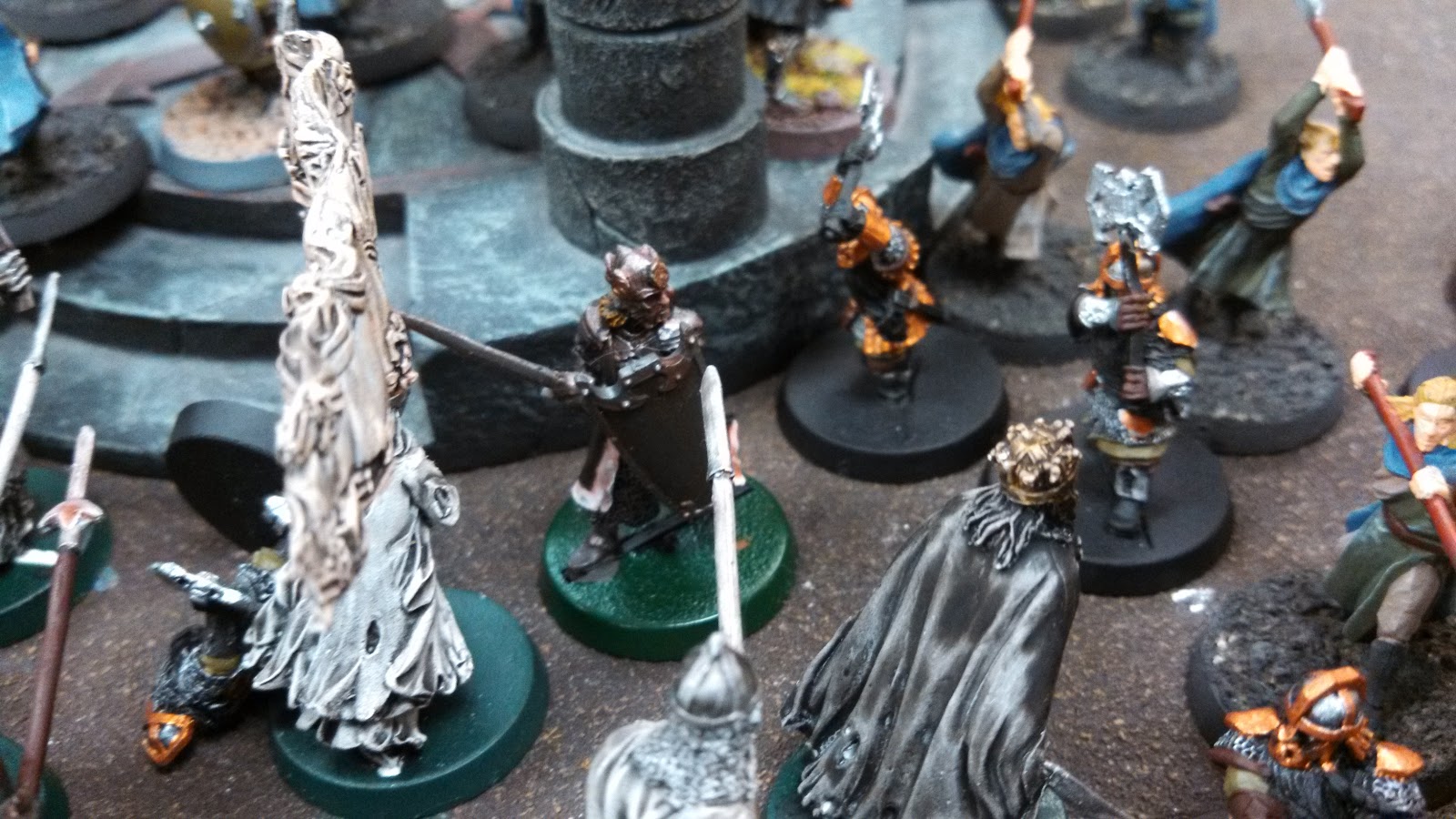
LotR SBG rules got an update in the form of the just released Hobbit rules. The major changes are as follow:

Heroic Uses of Might.
Heroic Move, Shoot, and Fight remains unchanged. There are four additional heroic actions.
Heroic March: allows all friendly models within 6" to increase their movement by 3" if on foot, 5" if mounted. Models cannot charge as part of the march. It is not clear to me whether this increases movement is in addition to other bonuses, such as that provided by a Uruk Hai drummer for instance.
Heroic Channelling: allows magically effect of spells casted to be more powerful.
Heroic Accuracy: allows all friendly models within 6" to reroll their in the way roll when shooting.
Heroic Strike: allows the hero to increase his Fight by D6 and it applies before any other effect (such as transfix).

Monster and Monster Mount Attacks.
Rend: all attacks against one model but applied against its strength rather than defense.
Hurl: allows the monster to grab a model in base to base whose strength is less than the monster's, compare Strength +D6 and if the monster's is higher, the model is thrown a number of inches equal to difference in the modified roll off. The hurled model suffers a S3 hit for each model caught in the path of the hurl, and an additional S6 hit at the end. This appear great against multi wound models.
Barge: all enemy models in the fight back away 3" chosen by the monster and the monster then gets a D6" charge to fight again. This seems the equivalent of heroic fight and thus not available if the monster is part of a heroic fight.
Note: a chariot is considered a monstrous mount so it can hurl, rend and barge? LOL!

Special Weapon Attacks.
Declared before the Fight/Duel rolls.
Piercing strike with axes and picks: wielder gains D3 strength but defend at minus D3. Does a two handed axe also get to pierce?
Stun with clubs and staffs: wielder cannot wound but a defender is reduced to Fight 1 and Attack 1 on a roll of 4+. This is only good when attacking with a companion. But since this attack is declared after the fight/duel has already been won, I am not sure how reducing the enemy's Fight makes a difference.
Whirl with flails, scourges and whips: wielder is fight 1 but a win allows a strike against all enemy models in base to base. This should be used when surrounded.
Bash with maces, mauls and hammers: allows the wielder to roll off on a D6 + Strength against a single enemy model in the fight. If the wielder's roll is equal to or greater than the defender, the defender is knocked to the ground. Not sure if an infantry model can bash a cavalry model to the ground, or even a monster/monster mount.
Feint with daggers and swords: allow a model to fight at minus D3 fight but reroll to Wound roll of 1. Should always be used when facing a higher Fight enemy.
Support with spear and pikes: allows a model to directly fight one base away rather than adds an attack to the front model. It appears pikes are no different from spears.
Elven blade wielder wins tie Fight rolls on 3+ rather than 4+ unless fighting against another elven blade. Khand chieftains and kings wield elven blades by the way.

Heroic Uses of Might.
Heroic Move, Shoot, and Fight remains unchanged. There are four additional heroic actions.
Heroic March: allows all friendly models within 6" to increase their movement by 3" if on foot, 5" if mounted. Models cannot charge as part of the march. It is not clear to me whether this increases movement is in addition to other bonuses, such as that provided by a Uruk Hai drummer for instance.
Heroic Channelling: allows magically effect of spells casted to be more powerful.
Heroic Accuracy: allows all friendly models within 6" to reroll their in the way roll when shooting.
Heroic Strike: allows the hero to increase his Fight by D6 and it applies before any other effect (such as transfix).
Monster and Monster Mount Attacks.
Rend: all attacks against one model but applied against its strength rather than defense.
Hurl: allows the monster to grab a model in base to base whose strength is less than the monster's, compare Strength +D6 and if the monster's is higher, the model is thrown a number of inches equal to difference in the modified roll off. The hurled model suffers a S3 hit for each model caught in the path of the hurl, and an additional S6 hit at the end. This appear great against multi wound models.
Barge: all enemy models in the fight back away 3" chosen by the monster and the monster then gets a D6" charge to fight again. This seems the equivalent of heroic fight and thus not available if the monster is part of a heroic fight.
Note: a chariot is considered a monstrous mount so it can hurl, rend and barge? LOL!

Special Weapon Attacks.
Declared before the Fight/Duel rolls.
Piercing strike with axes and picks: wielder gains D3 strength but defend at minus D3. Does a two handed axe also get to pierce?
Stun with clubs and staffs: wielder cannot wound but a defender is reduced to Fight 1 and Attack 1 on a roll of 4+. This is only good when attacking with a companion. But since this attack is declared after the fight/duel has already been won, I am not sure how reducing the enemy's Fight makes a difference.
Whirl with flails, scourges and whips: wielder is fight 1 but a win allows a strike against all enemy models in base to base. This should be used when surrounded.
Bash with maces, mauls and hammers: allows the wielder to roll off on a D6 + Strength against a single enemy model in the fight. If the wielder's roll is equal to or greater than the defender, the defender is knocked to the ground. Not sure if an infantry model can bash a cavalry model to the ground, or even a monster/monster mount.
Feint with daggers and swords: allow a model to fight at minus D3 fight but reroll to Wound roll of 1. Should always be used when facing a higher Fight enemy.
Support with spear and pikes: allows a model to directly fight one base away rather than adds an attack to the front model. It appears pikes are no different from spears.
Elven blade wielder wins tie Fight rolls on 3+ rather than 4+ unless fighting against another elven blade. Khand chieftains and kings wield elven blades by the way.
Sunday, June 24, 2012
Dropzone Commander



 This is a new 10mm scale sci-fi war-game from Hawk Wargames. Note that the buildings are made by them as well.
Saturday, February 11, 2012
Book Review: Legion of the Damned

I recently completed reading this book on my nook. I believe it will be out in paperback later this month. Firstly, this book is mostly about the Excoriator Space Marines, a second chapter founding from the Imperial Fist. The Legion of the Damned do show up at the end though so the title is not completely a misrepresentation. Once this fact is accepted, then you can relax and enjoy the book, and in my opinion, one of the better read from the Black Library.
The main character is the Scourge, equivalent to a chapter champion, who is seeking to to redeem himself for a previous failure against the Alpha Legion (they are everywhere don't you know). He is tempted to wallow in his own despair but instead is forced to duty with men who loath him. There is nice juxtaposition here not just between despair and action, but also command and service, honor to self and honor to his chapter. And only the periphery of his awareness he is watched but his own personal demon. The character development is good for the Scourge, as well as others about him. There are the Ecclesiarch he is forced to serve, and the humans who serve as his attendants. There are also Sisters of Battle and Chaos Space Marines.
The writing is crisp and well paced. The plot unfold with some nice twist and surprises; stereotypes are present (perhaps more as archetypes) but not indulged. There are no superlatives and in large part, believable, yes believable even though 40k. Though the writing is mostly from the Scourge perspective, there are sufficient little vignettes to provide a 360 view of the event.
This is the first book by Rib Sanders I have read and I am rather pleased. Along with Aaron Dembski-Bowden he is an author to read for 40k. I look forward to his next book.
Update: Rob Sander just announced he is writing a novella for the upcoming Horus Heresy compilation here. This is most excellent. One of my favorite Black Library author writing about my favorite chaos marines legion.
Saturday, December 17, 2011
WotR: Skirmish
These rules modifications are meant to play WotR without moving trays. Why?
1. Skirmish game looks better on the table top.
2. Skirmish game allows better integration of terrain.
3. The WotR rule book contains all the profiles whereas many SBG sourcebooks are no longer available.
The rules are changed as follow:
I. Companies & Formation (p24)
Movement trays are not used.
There are no facings.
All models within a formation must remain within 1” of another model of the same formation.
II. Dice and Measuring (p27)
Measuring is from each model.
III. Move Phase (p32)
No model may move more than its move allowance.
All models within a formation must remain within 1” of another model of the same formation.
IV. Shoot Phase (p36)
A. Calculate Number of Dice
Shooting Directly: Each model with line of sight and range to a target generate one shooting die.
Accuracy Bonus: Apply for every 8 infantry models shooting directly, 2 cavalry models shooting directly, or single monster model shooting directly.
Supporting Fire: For every 8 infantry models, 2 cavalry models, or monster model in the formation that cannot shoot directly but has range to the formation’s target, an extra shooting die is generated.
B. Removing Casualties
Casualty models to be removed must start with the model furthest away from any command model of the formation. A command model in the formation is any any upgrade listed in the Command Companies section (p60) and any epic hero in the formation.
An infantry formation reduced to four models or less is removed in total. A cavalry formation reduced to one model it must also be removed as casualty.
V. Charge Phase (p42)
Choose Spearhead. The spearhead must be a command model upgrade listed in the Command Companies section (p60) or any epic hero in the formation. If the formation does not have a command model or a hero, then the closest model to the charged formation is the spearhead.
Move Remaining Companies. Change to move remaining models.
VI. Fight Phase (p46)
A. Calculate Number of Dice
1. Fighting Directly: Each infantry or cavalry model in base to base contact generates one die. Each monster model in base to base contact generates a number of attach dice per its profile. Each Galadhrim Knight model generates two dice.
2. Combat Modifiers:
a. Charging infantry and monsters: +1 die for every eight models.
b. Charging cavalry and flying monsters against infantry and monsters: + 3 dice for every model
c. Charging cavalry and flying monsters against cavalry and flying monsters: +1 die for every model
d. Battle Skill: +1 for every fight value higher than charged model for every 8 charging infantry models, every 2 cavalry models, or every monster. In addition bonus dice are generated for the difference between single hero model fight value and the target formation fight value .
e. Unstoppable Charge: +D3 dice for every 8 charging infantry models, every 2 cavalry models, or every monster.
f. Disordered: the maximum number of dice for a disordered formation is 1 for every 8 infantry models, every 2 cavalry models, or every monster.
B. Removing Casualties
Casualty models to be removed must start with the model furthest away from any command model of the formation. A command model in the formation is any any upgrade listed in the Command Companies section (p60) and any epic hero in the formation.
An infantry formation reduced to four models or less is removed in total. A cavalry formation reduced to one model it must also be removed as casualty.
Edit:
So we tried out a 500 points game this week and it did not work. This all comes down to the tactical lost of clear companies in both the movement phase, placement of chargers, as well as facing in combat.
1. Skirmish game looks better on the table top.
2. Skirmish game allows better integration of terrain.
3. The WotR rule book contains all the profiles whereas many SBG sourcebooks are no longer available.
The rules are changed as follow:
I. Companies & Formation (p24)
Movement trays are not used.
There are no facings.
All models within a formation must remain within 1” of another model of the same formation.
II. Dice and Measuring (p27)
Measuring is from each model.
III. Move Phase (p32)
No model may move more than its move allowance.
All models within a formation must remain within 1” of another model of the same formation.
IV. Shoot Phase (p36)
A. Calculate Number of Dice
Shooting Directly: Each model with line of sight and range to a target generate one shooting die.
Accuracy Bonus: Apply for every 8 infantry models shooting directly, 2 cavalry models shooting directly, or single monster model shooting directly.
Supporting Fire: For every 8 infantry models, 2 cavalry models, or monster model in the formation that cannot shoot directly but has range to the formation’s target, an extra shooting die is generated.
B. Removing Casualties
Casualty models to be removed must start with the model furthest away from any command model of the formation. A command model in the formation is any any upgrade listed in the Command Companies section (p60) and any epic hero in the formation.
An infantry formation reduced to four models or less is removed in total. A cavalry formation reduced to one model it must also be removed as casualty.
V. Charge Phase (p42)
Choose Spearhead. The spearhead must be a command model upgrade listed in the Command Companies section (p60) or any epic hero in the formation. If the formation does not have a command model or a hero, then the closest model to the charged formation is the spearhead.
Move Remaining Companies. Change to move remaining models.
VI. Fight Phase (p46)
A. Calculate Number of Dice
1. Fighting Directly: Each infantry or cavalry model in base to base contact generates one die. Each monster model in base to base contact generates a number of attach dice per its profile. Each Galadhrim Knight model generates two dice.
2. Combat Modifiers:
a. Charging infantry and monsters: +1 die for every eight models.
b. Charging cavalry and flying monsters against infantry and monsters: + 3 dice for every model
c. Charging cavalry and flying monsters against cavalry and flying monsters: +1 die for every model
d. Battle Skill: +1 for every fight value higher than charged model for every 8 charging infantry models, every 2 cavalry models, or every monster. In addition bonus dice are generated for the difference between single hero model fight value and the target formation fight value .
e. Unstoppable Charge: +D3 dice for every 8 charging infantry models, every 2 cavalry models, or every monster.
f. Disordered: the maximum number of dice for a disordered formation is 1 for every 8 infantry models, every 2 cavalry models, or every monster.
B. Removing Casualties
Casualty models to be removed must start with the model furthest away from any command model of the formation. A command model in the formation is any any upgrade listed in the Command Companies section (p60) and any epic hero in the formation.
An infantry formation reduced to four models or less is removed in total. A cavalry formation reduced to one model it must also be removed as casualty.
Edit:
So we tried out a 500 points game this week and it did not work. This all comes down to the tactical lost of clear companies in both the movement phase, placement of chargers, as well as facing in combat.
Subscribe to:
Posts (Atom)